
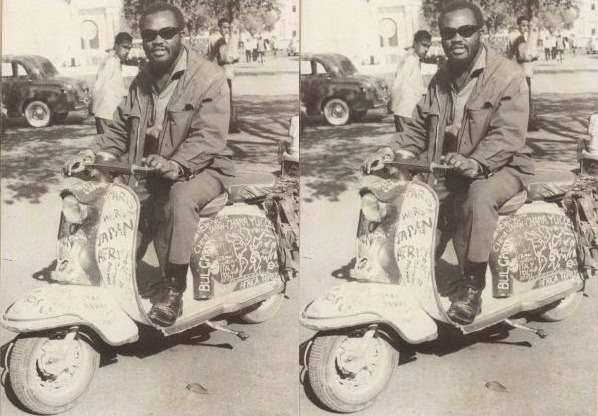
 Just as Europe had Christopher Columbus, Africa had Moshood Adisa Olabisi Ajala popularly known as “Ajala Travel” for his tremendous recorded history of his tour around the world. Ajala was born of Nigerian parents in Ghana but raised in Nigeria before going to America at the age of 18 to further his studies. Ajala had dreams of becoming a medical doctor and returning to Nigeria to ‘wage war on voodoo and other superstitions’ in his words, being raised by a traditionalist father but eventually found another path in life as a traveler which gave him his recognition today.
Ajala hit the spotlight in 1952 when he decided to embark on a lecture tour across the United States from Chicago to Los Angeles, solely on a bicycle. At 22, he began his tour from Chicago on the 12th of June 1952 covering an incredible 2,280 miles and then arrived the Los Angeles City Hall on 10th of July, two days ahead of his 30-day schedule and was received by the city mayor Fletcher Bowron. In sharing his experience of the cross-country tour, he described his journey as generally fine and only face one nasty incident in Topeka, Kansas which landed him in jail for 44 hours after the white YWMA refused him a room and called the police when he protested, which was a common occurrence black people faced back then in the United States’ segregation era. Ajala filed a suit against the Topeka YMCA and its secretary through the Nigerian ambassador in Washington and was determined to not let anyone maltreat him as a black man from Nigeria and get away with it.
However, the main purpose and goal of Ajala’s journey as a psychology junior at the Roosevelt College in Chicago which included stops to deliver lectures at 11 major cities was to educate the American public on the progress of his native West African country of Nigeria. Ajala made sure to complete his tour wearing native Nigerian attires which were described as ‘elaborately flowered robes with a felt-like head-dresses to match’, which he believed stating that ‘…will show and prove to Americans that we do not go about nakedly in loin clothes.’ Following his brave bicycle trip across the United States, Ajala became loved by many so much that several newspaper journalists began surrounding him turning him into a celebrity overnight. Several deals, endorsements, and contracts came pouring in, among which was a movie contract he signed with Eagle-Lion Studios in Hollywood in August 1955, involving making a series of drama and spy films with European and African backgrounds.
In March 1953, Ajala’s glorious fame took a negative turn when the police of Beverly Hills, California arrested and jailed on three felony charges of one count of forgery, two grand theft, and three frivolous cheque charges. Being a promiscuous young man, he was also sued by a former Chicago nurse for refusing to accept paternity of his child. Ajala who pled not-guilty to the forgery charges claiming he was duped by a white ex-bank accountant was eventually found guilty of forgery and was to be deported from the United States of America at the age of 24 coupled with the fact that he failed to maintain his studies at the Santa Monica Junior College, thus invalidating his visa. He was, however, not ready to retire from the U.S and caused a scene by climbing an 80-foot radio tower threatening to kill himself as he cried out; ‘I would rather leap to my death’ than be deported. Ajala who was on the tower for almost 24 hours subsequently fell to the ground from a height of 15 feet but was lucky to leave with just a back sprain after being examined by a doctor. Ajala tried severally to defy his deportation due to what the U.S immigration officials referred to as fear of facing a ‘tribalistic execution’ in Nigeria, was finally deported to England, but vowed to return to the States to resume his acting career which he did in 1954 after spending nine months in Canada perfecting his acting skills.
He subsequently embarked on a global tour to many other countries around the world such as India, Russia (then USSR), Jordan, Iran, Jordan, Israel and Australia using nothing but a motor-scooter where he met some of the most powerful people in the world such as Sir Abubakar Tafawa Balewa Nigeria’s first prime minister, Marshal Ayub Khan of Pakistan, Golda Meir Israel’s first female prime minister , Makarios III of Cyprus, Jawarhalal Nehru of India, Nikita Khrushchev of the USSR, Mohammad Reza Shah Pahlavi the Shah of Iran, Gamal Nasser of Egypt, General Ignatius Acheampong of Ghana, Odinga Oginga, former vice president of Kenya and several others. He released a book titled An African Abroad documenting all his experiences of the trip which covered over 85 countries over a period of six years using his scooter.
Sadly, the much celebrated African traveler died on February 2, 1999, in penury after suffering a lingering stroke. It still remains a mystery how such a celebrated world traveler who spent his life seeing the world and was once the center of the spotlight died in a depleting state of extreme poverty with barely any family member by his side after having numerous wives and children. Ajala travel remains an inspiration as Africa’s greatest traveler who defied the odds of seeing the world at a time when black/African people had limited access to the significant things and little recognition around the world.