

Yesterday, the World Health Organisation officially announced the worldwide coronavirus outbreak as a pandemic. According to WHO Director-General Dr Tedros Adhanom Ghebreyesus, the announcement was spurred from its severity and wide-spreading nature. Also, the virus’ pandemic status was declared to tackle the level of inaction surrounding the global crisis.
The word, pandemic is enough to induce widespread panic for good reason. However, for most people, it begs the question: what exactly is a Pandemic? According to the WHO, a pandemic is the worldwide spread of a new disease. In fact, it is the highest possible level of disease’s spread. It is a measure of how many people have gotten sick from a particular disease and how far it has spread. Nonetheless, before a common illness reaches pandemic proportions, it has to exceed a few other levels. According to the Centers for Disease Control and Prevention (CDC), the levels are:
- Sporadic: When a disease occurs infrequently and irregularly.
- Endemic: A constant presence and/or usual prevalence of a disease or infection within a geographic area. (Hyperendemic, is a situation in which there are persistent, high levels of disease occurrence.)
- Epidemic: A sudden increase in the number of cases of the disease. This is usually, more than what’s typically expected for the population in that area.
- Pandemic: An epidemic that has spread over several countries or continents, affecting a large number of people.
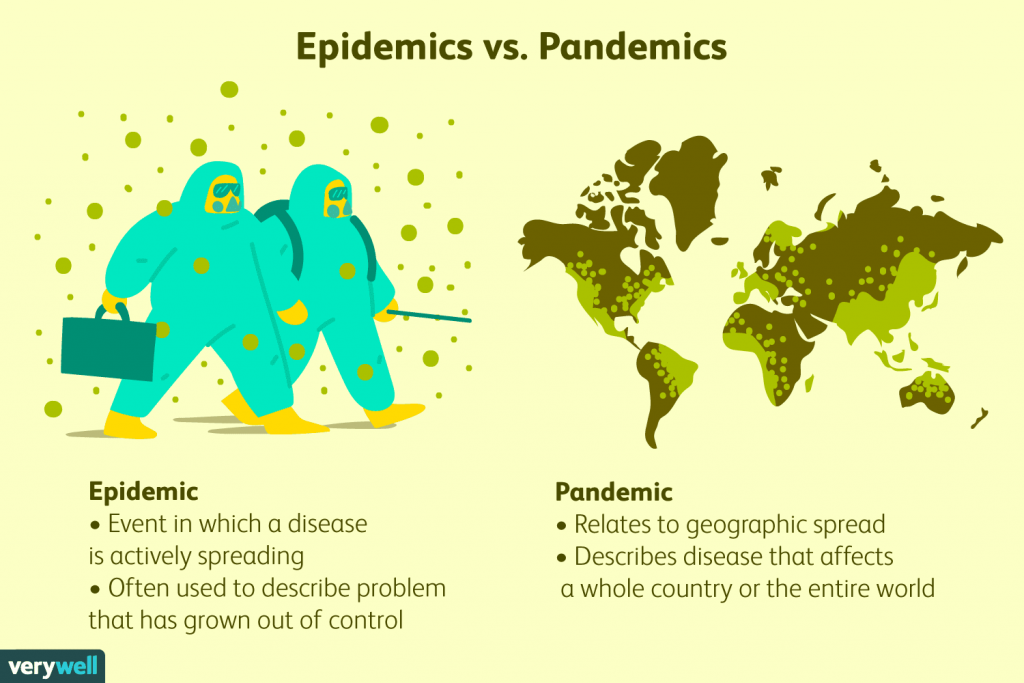
Epidemic vs Pandemic
An epidemic stays contained to a specific area—but when it extends into other countries or continents, it turns into a full-blown pandemic. PAndemics are also known as “Public Health Emergency of International Concern”, an example of which is the H1N1 Swine Flu of 2009.
When an epidemic crosses over into pandemic, the biggest difference is that more governments are involved in attempting to prevent the progression of the disease and, potentially, treat the people who have it.
Technically, an epidemic only refers to infectious diseases, but it’s also been applied to non-diseases, like gun violence and opioids. Similarly, what constitutes a pandemic is also a bit unclear. If we were to stick stringently to the definition, every illness that crosses the border from one country into another is a pandemic.
So, while something could have crossed borders, if only a few people in other countries have reported being sick it doesn’t have the same urgency or fear factor as other illnesses that have been declared an international emergency.
It is important to note that these classifications were not made to instill unreasonable fear and panic. However, they are supposed to tell us that there’s a sense of urgency to fix the problem.